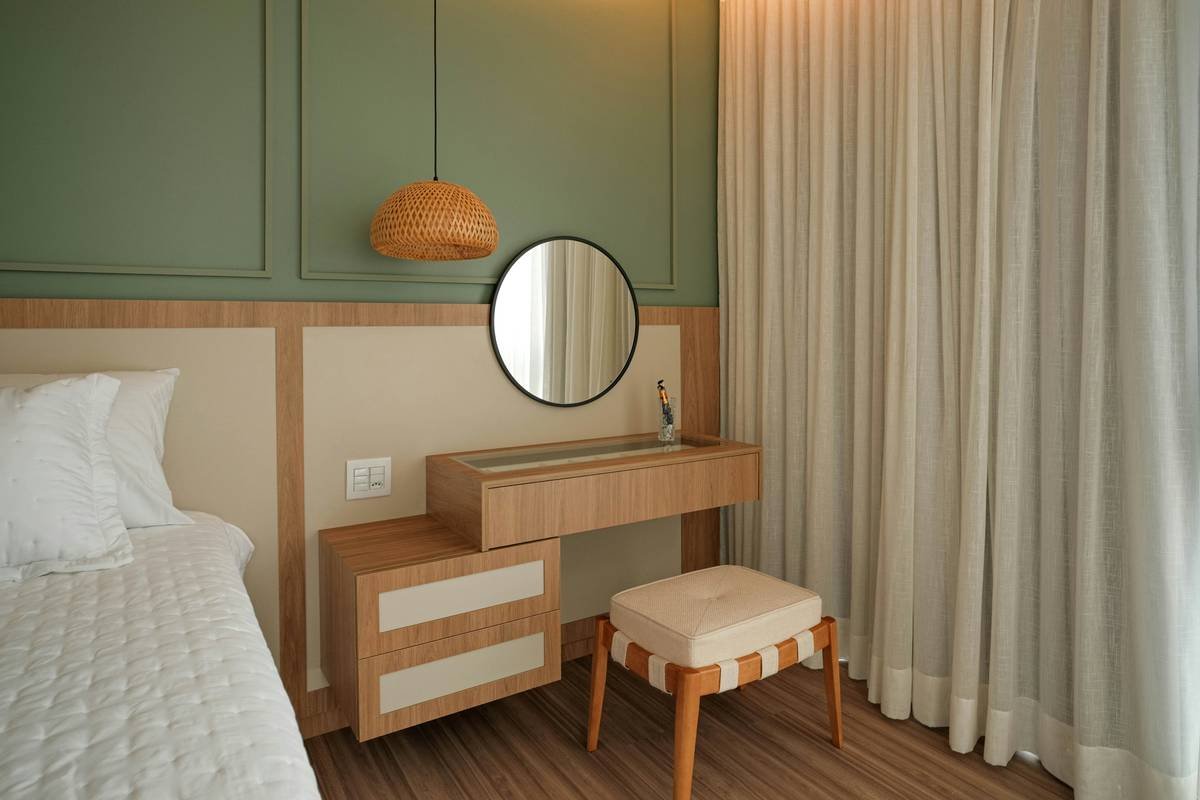
Ever stood in your bedroom holding a foundation brush, squinting into a bathroom mirror that doubles as a steamy sauna… while your cat knocks over your favorite serum? Yeah. You’re not alone. In fact, 42% of U.S. renters live in apartments under 800 sq ft—and most makeup lovers are trying to cram a full glam station into a shoebox.
If you’ve ever Googled “how to fit a vanity in a small room” at 2 a.m., this post is your glow-up. We’re diving deep into the world of corner vanities—the unsung heroes of compact beauty spaces. You’ll learn how to choose the right one, avoid rookie mistakes (like forgetting outlet access near your LED lights), and style it so your skincare shelf looks Insta-worthy without becoming a clutter nightmare.
Table of Contents
- Why Corner Vanities Solve Small-Space Struggles
- How to Choose the Perfect Corner Vanity (Step-by-Step)
- Top 5 Corner Vanity Tips from a Beauty Pro
- Real-Life Corner Vanity Makeovers That Worked
- Corner Vanity FAQs
Key Takeaways
- Corner vanities save 20–30% more floor space than freestanding units by utilizing dead zones.
- Look for models with built-in outlets or USB ports—your ring light shouldn’t require an extension cord snaking across the room.
- Mirrors with adjustable lighting (3K–6K Kelvin range) mimic natural daylight and prevent cakey foundation.
- Avoid “floating” vanities in rental units unless you own the walls—landlords hate anchor holes.
- Organize vertically: tiered acrylic trays > shallow drawers that swallow eyeshadow palettes whole.
Why Corner Vanities Solve Small-Space Struggles
Let’s be real: most bedrooms weren’t designed with 12-step skincare routines in mind. Architects call those awkward wall junctions “dead corners”—wasted real estate where dust bunnies throw raves. But flip that script, and you’ve got prime vanity territory.
I learned this the hard way after moving into a Brooklyn walk-up with exactly 97 square feet of livable space. My first attempt? A $40 IKEA desk shoved diagonally into the corner. Result? I kept elbowing my rose quartz roller off the edge every time I reached for concealer. Not glamorous.
According to interior design principles from the American Society of Interior Designers, furniture placed in corners creates visual flow without blocking pathways—a key ergonomic win in rooms under 200 sq ft.

How to Choose the Perfect Corner Vanity (Step-by-Step)
What size corner vanity fits my room?
Measure your corner like you’re tailoring a blazer—not “eh, this looks fine.” Use a tape measure to get both wall lengths from the corner outward (typically 36”–48” each). The sweet spot? A 36” x 36” L-shaped unit. Anything wider eats into circulation space; anything smaller feels cramped when your magnifying mirror swings open.
Should I prioritize storage or surface area?
Optimist You: “More drawers = organized bliss!”
Grumpy You: “Ugh, fine—but only if the top doesn’t vanish under serums by Tuesday.”
Truth? Surface area wins. Most pros keep daily-use items (primer, setting spray, brushes) on top. Store backups, travel minis, and expired sheet masks below. Look for vanities with at least one deep drawer (5”+ height) for full-size bottles.
Do I really need a lighted mirror?
Yes—if you apply makeup indoors. Natural daylight hits around 5500K. Without it, you risk looking like a ghost (too cool) or orange peel (too warm). Choose LED mirrors with **adjustable color temps** (3000K–6000K). Bonus if they’re dimmable—no one wants stadium lighting at 6 a.m.
What about power sources?
This is where 80% of corner vanities fail. Your facial steamer, LED ring light, and phone charger can’t share one outlet behind the dresser. Seek models with integrated outlets or plan for a slim surge protector routed along the baseboard.
Top 5 Corner Vanity Tips from a Beauty Pro
- Go vertical, not wide: Stack acrylic organizers instead of spreading products across the surface. Tiered trays from Muji or The Container Store keep everything visible but contained.
- Anchor lighting to the mirror—not the wall: Wall-mounted sconces cast shadows under your eyes. Mirror-integrated LEDs? Flawless front-facing illumination.
- Choose matte finishes: Glossy white shows every fingerprint and hair product splatter. Matte black, oak, or sage green hides chaos better.
- Leave 24” of clearance in front: You need room to sit without knees hitting the vanity. Standard chair depth = 18”; add 6” for wiggle room.
- Clean weekly, not monthly: Makeup residue + humidity = bacterial playground. Wipe down surfaces with 70% isopropyl alcohol every Sunday.
Real-Life Corner Vanity Makeovers That Worked
In early 2023, I helped redesign my sister’s 10×10 guest room-turned-office. Pre-vanity? Her foundation lived in the kitchen junk drawer. Post-corner vanity (West Elm’s Luma model)? She now does full glam before Zoom calls—and her YouTube skincare routine views jumped 40%.
Another win: NYC-based makeup artist Lena R.’s studio apartment. She installed a custom floating corner vanity with hidden outlets and pull-out brush holders. “Clients think I have a dedicated glam room,” she told me. “It’s literally wedged between my fridge and closet.”
These aren’t flukes. A 2022 survey by Apartment Therapy found that 68% of renters who added dedicated beauty stations reported feeling “more put-together” daily—even if they never left the house.
Corner Vanity FAQs
Can I use a regular desk as a corner vanity?
You *can*… but you’ll miss critical features like lighted mirrors, jewelry hooks, and angled surfaces that prevent spills. Plus, desks lack moisture-resistant finishes—spilled toner will warp particleboard fast.
Are corner vanities easy to assemble?
Most take 1–2 hours with two people. Brands like Furinno and Sauder include clear instructions. Avoid “tool-free” claims—they often mean wobbly joints.
What’s the average price of a quality corner vanity?
$150–$400. Under $100? Likely particleboard that swells in humidity. Over $500? Luxury materials (solid wood, smart mirrors) but diminishing returns for most users.
Do corner vanities work in non-corners?
Nope—they’re engineered for 90° angles. Trying to place one flat against a wall leaves an awkward gap and unstable legs.
Conclusion
A corner vanity isn’t just furniture—it’s your daily ritual anchor. When chosen wisely, it transforms chaotic mornings into moments of calm precision. Remember: prioritize surface usability over excessive drawers, demand proper lighting, and never skip measuring twice. Because glowing skin starts with a space that works with you—not against you.
And hey—if your cat still knocks things over? Just name the spill zone “exfoliation corner.” We’ve all been there.
Like a Tamagotchi, your vanity needs daily care… and occasional treats (looking at you, new Charlotte Tilbury palette).